Survival Korean for Travelers: The Phrases You'll Actually Use in Korea
 Yunjae
Some links in this post are affiliate links. If you book through them, I earn a small commission at no extra cost to you.
Going to Korea soon? Scared you won't be able to read a single sign or understand a word anyone says?
Good news: you don't need to learn Korean. You need about 30 words, three apps and a few local rules nobody tells you at the airport.
I'm Yunjae. I'm Korean, and these are the phrases I'd teach a friend the night before their flight. No textbook, no alphabet lessons. Just what you'll actually say and see.
Short on time? Get the free Survival Korean PDFs → A 2-page cheat sheet to save to your phone, plus a 14-page guide for the plane.
The 6 Korean phrases you'll use every day
How to read this: the first column is what you'll see written. The second is roughly how it sounds. Close enough is fine, people will get it. When in doubt, show your screen.
| Korean | Say it like | Meaning |
|---|---|---|
| 안녕하세요 | an-nyeong-ha-se-yo | Hello |
| 감사합니다 | gam-sa-ham-ni-da | Thank you |
| 이거 주세요 | i-geo ju-se-yo | This one, please (point at the menu) |
| 사장님! | sa-jang-nim | Excuse me! (to call staff) |
| 화장실 어디예요? | hwa-jang-sil eo-di-ye-yo? | Where's the toilet? |
| 잘 먹었습니다 | jal meo-geot-seum-ni-da | I ate well (say it on the way out) |
Why not 고마워요? Lots of phrase lists teach 고마워요 (go-ma-wo-yo). It also means thank you, but it's for friends or people younger than you. Say it to a 60-year-old restaurant owner and it sounds wrong. 감사합니다 is the safe one, every time.
Why 사장님? It means "boss." Everyone uses it to call staff, even for the part-timer. Or just press the bell on the table.
Why 잘 먹었습니다? It's a cheat code. Say it as you leave a restaurant and watch the owner light up. Nobody expects it from a foreigner.
When you walk into a shop, staff will say 어서 오세요 (eo-seo o-se-yo), "welcome." You don't have to answer. A nod or 안녕하세요 is plenty.
Korean signs you'll see everywhere
You don't need to read Hangul. Learn to spot these words like logos. Curious anyway? My free alphabet guide teaches all 40 letters with food.
At shops and restaurants
| Korean | Say it like | Meaning |
|---|---|---|
| 영업중 | yeong-eop-jung | Open |
| 영업종료 | yeong-eop-jong-ryo | Closed for the day |
| 휴무 | hyu-mu | Closed / day off |
| 브레이크타임 | break time | Closed for a break, often 3 to 5 pm |
| 셀프 | sel-peu | Self-service (water, cups, side dishes) |
| 현금만 가능 | hyeon-geum-man ga-neung | Cash only |
| 1인분 / 2인분 | il-in-bun / i-in-bun | 1 portion / 2 portions |
| 화장실 · 남 / 여 | hwa-jang-sil · nam / yeo | Toilet · Men / Women |
| 미세요 / 당기세요 | mi-se-yo / dang-gi-se-yo | Push / Pull |
Getting around and rules
| Korean | Say it like | Meaning |
|---|---|---|
| 역 | yeok | Station |
| 출구 / 입구 | chul-gu / ip-gu | Exit / Entrance |
| 환승 | hwan-seung | Transfer |
| 타는 곳 | ta-neun got | Where to board / platform |
| 금연 | geum-yeon | No smoking |
| 흡연구역 | heu-byeon-gu-yeok | Smoking area |
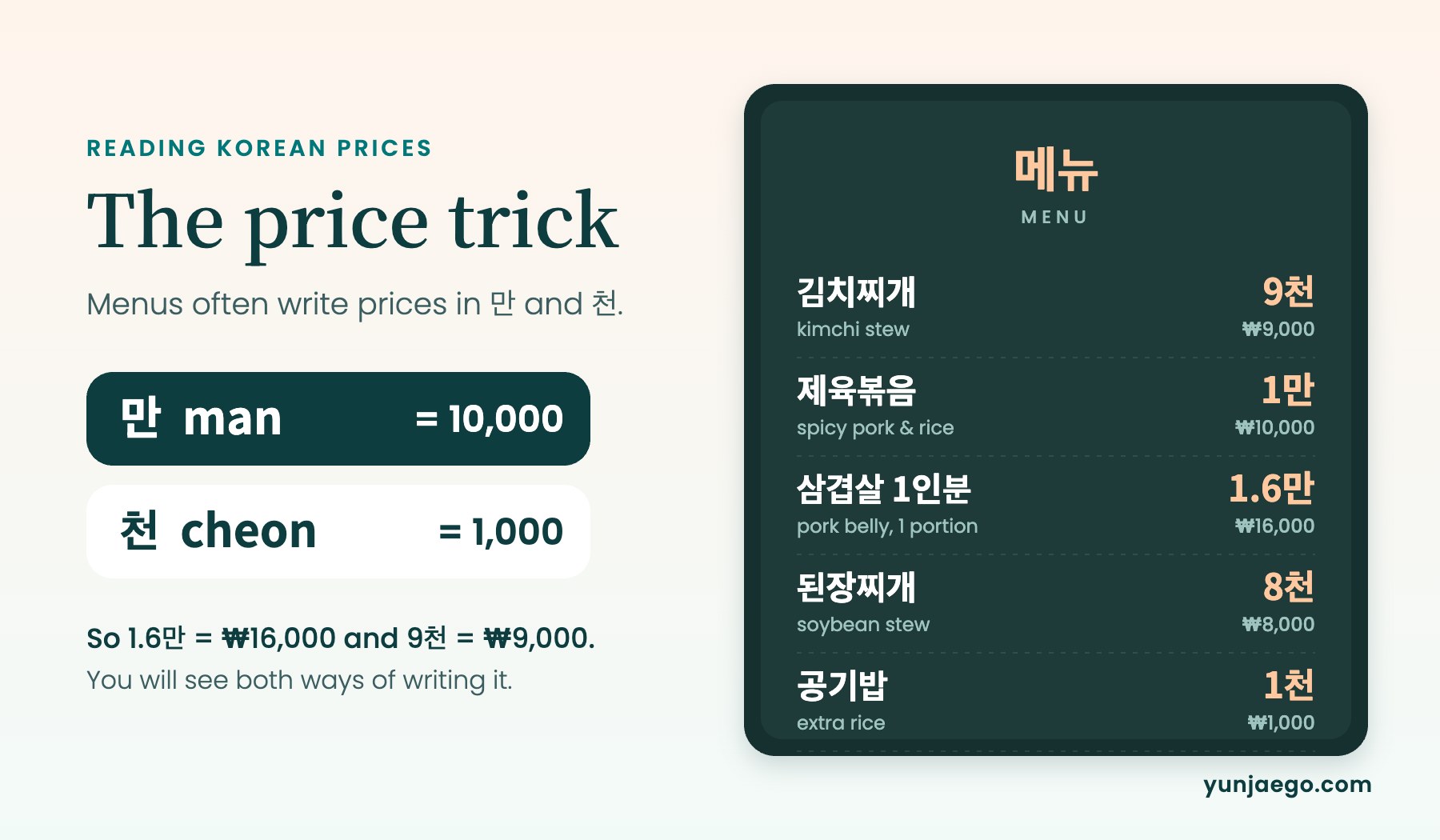
Price trick: 만 (man) = 10,000 and 천 (cheon) = 1,000. So a menu saying 1.2만 means ₩12,000. You'll see both ways of writing it.
How to order food in Korean
Every phrase you need, from the door to the bill.
| Korean | Say it like | Meaning |
|---|---|---|
| 몇 분이세요? | myeot bu-ni-se-yo? | How many people? (they'll ask you) |
| 두 명이요 / 혼자요 | du myeong-i-yo / hon-ja-yo | Two people / Just me |
| 이거 뭐예요? | i-geo mwo-ye-yo? | What's this? |
| 저거 주세요 | jeo-geo ju-se-yo | I'll have that (point at the next table) |
| 반찬 더 주세요 | ban-chan deo ju-se-yo | More side dishes, please (they're free) |
| 2인분 주세요 | i-in-bun ju-se-yo | Two portions, please |
| 공기밥 하나 주세요 | gong-gi-bap ha-na ju-se-yo | One more bowl of rice |
| 안 맵게 해 주세요 | an maep-ge hae ju-se-yo | Not spicy, please |
| 계산해 주세요 | gye-san-hae ju-se-yo | Bill, please |
| 카드 돼요? | ka-deu dwae-yo? | Can I pay by card? |
| 너무 맛있어요 | neo-mu ma-si-sseo-yo | It's so good! (say it to the owner) |
One honest note on 안 맵게: it's not always possible. In many places the sauce is made in advance, so "not spicy" can mean "a bit less spicy."
Restaurant rules nobody tells you
- No tipping, so the water is on you. Many places are 셀프 (self-service). Water, cups and extra side dishes are at a station by the wall.
- Table looks empty? Nobody forgot you. Spoons and chopsticks are in a drawer on the side of the table, or in a box on top. Set them yourself.
- Pay at the counter. Usually one bill per table, paid on the way out. No need to wait for a check.
- Korean BBQ: let them grill it. Peek through the window and pick a place where staff grill at the tables. Grilling it yourself the first time honestly isn't that fun. Grill turned black? 불판 갈아주세요 (bul-pan ga-ra-ju-se-yo), "please change the grill."
- BBQ is usually 2 portions minimum. Eating alone? Look for 1인분 가능 (il-in-bun ga-neung), "one portion OK."
- Skip the lunch rush. From 11:30 to 12:40 office workers fill every restaurant. Go after 12:40.
- Kiosk or tablet? Look for the English button. If your foreign card doesn't work there, pay at the counter.
- Floor seating? Shoes off before you step up.
Ordering coffee, beer and soju in Korean
Say it like a Korean word, not like you're ordering in New York: a-me-ri-ka-no, ra-tte, ka-seu. Flat, syllable by syllable. Staff get it faster than perfect English.
| Korean | Say it like | Meaning |
|---|---|---|
| 아이스 아메리카노 주세요 | a-i-seu a-me-ri-ka-no ju-se-yo | Iced americano, please (locals just say 아아, a-a) |
| 따뜻한 거요 | tta-tteu-tan geo-yo | Hot, please |
| 먹고 갈게요 / 테이크아웃이요 | meok-go gal-ge-yo / te-i-keu-a-u-si-yo | For here / To go |
| 카스 하나 주세요 | ka-seu ha-na ju-se-yo | One Cass (beer), please |
| 소주 한 병 주세요 | so-ju han byeong ju-se-yo | One bottle of soju, please |
| 한 병 더 주세요 | han byeong deo ju-se-yo | One more bottle, please |
| 건배! | geon-bae | Cheers! |
- Iced americano in winter? Koreans drink it all year round. That doesn't mean you have to. Hot coffee is always on the menu.
- The bottle skill. Bar packed and loud? Don't shout. Catch a staff member's eye, lift your empty bottle and hold up fingers for how many. Works every time.
- Order food, not just drinks. Most Korean bars expect each table to order at least one 안주 (an-ju), food you eat with drinks.
- Soju is around 16%. A bit stronger than wine, and it goes down easy. That's the trap.
Food allergies in Korea: what to say (and the honest part)
| Korean | Say it like | Meaning |
|---|---|---|
| 저 땅콩 알레르기 있어요 | jeo ttang-kong al-le-reu-gi i-sseo-yo | I'm allergic to peanuts |
| 땅콩 들어가요? | ttang-kong deu-reo-ga-yo? | Is there peanut in it? |
| 땅콩 빼 주세요 | ttang-kong ppae ju-se-yo | Please leave out the peanuts |
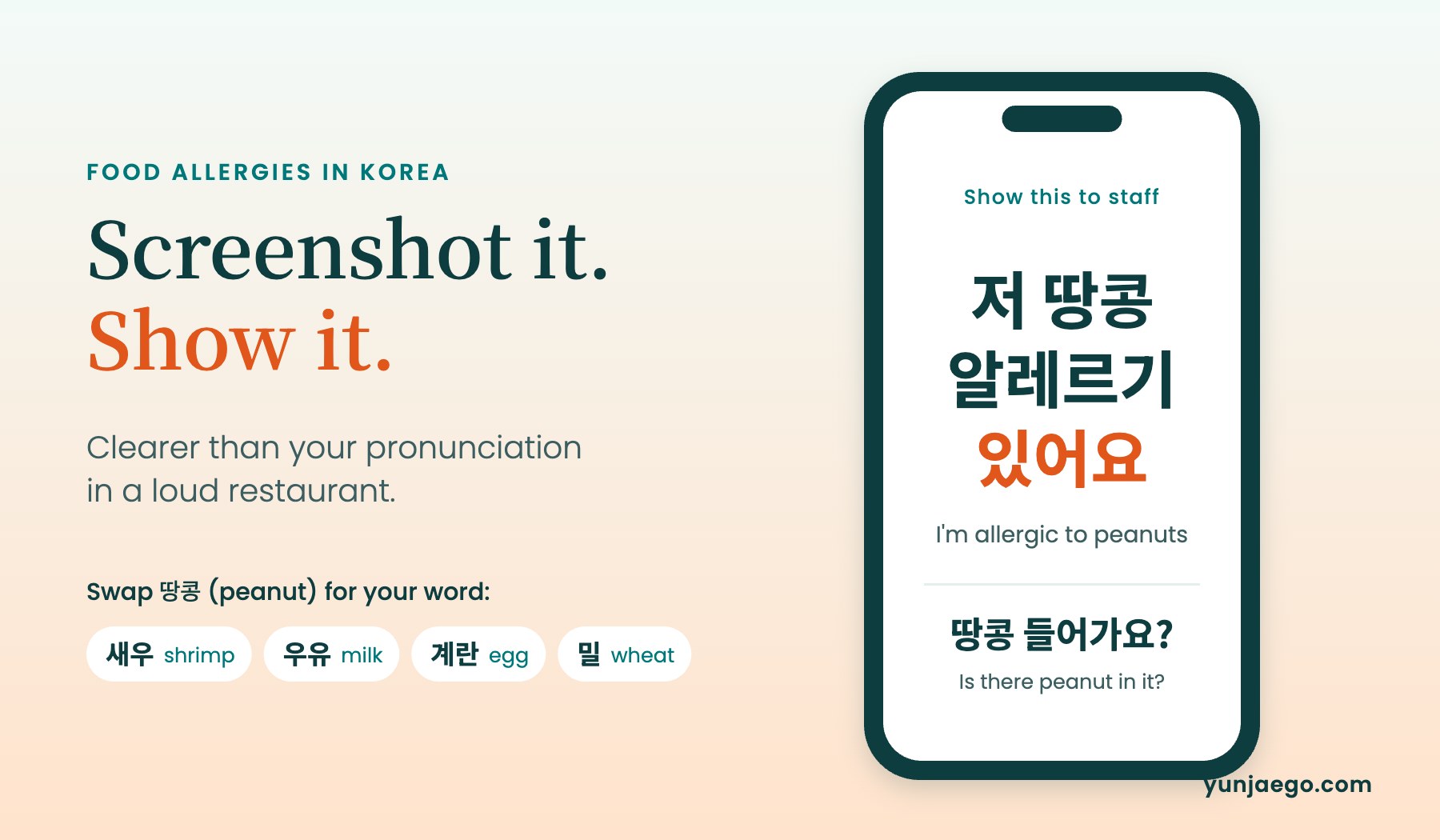
Swap 땅콩 (peanut) for your word: 견과류 (gyeon-gwa-ryu) nuts · 새우 (sae-u) shrimp · 갑각류 (gap-gak-ryu) shellfish · 우유 (u-yu) milk · 계란 (gye-ran) egg · 밀 (mil) wheat · 메밀 (me-mil) buckwheat.
The honest part: most small restaurants make sauces and broths in big batches or buy them premade. The staff often don't know exactly what's inside, and they can't take it out of your bowl. They're not being rude. It's just how those kitchens work.
So do this:
- Pick dishes where you can see what's in them. Grilled meat, rice and clear soups are easier than sauces and stews.
- Screenshot the phrase and show your screen. It's clearer than your pronunciation in a loud restaurant.
- On packaged food, look for the box marked 알레르기 유발물질 (allergens). Papago's camera translates it.
- Severe allergy? Carry your medication. Don't rely on "no peanuts, please."
Vegetarian? It's hard here. Broths are often made with anchovy or beef, and kimchi usually has fish sauce. 고기 빼 주세요 (go-gi ppae ju-se-yo) removes the meat you can see, not the broth.
Korean convenience store phrases
You barely need to talk at a Korean convenience store. You just need to understand the three questions at the counter. 네 (ne) = yes and 아니요 (a-ni-yo) = no answer all of them.
| Korean | Say it like | Meaning |
|---|---|---|
| 봉투 필요하세요? | bong-tu pi-ryo-ha-se-yo? | Need a bag? (bags cost a little) |
| 영수증 드릴까요? | yeong-su-jeung deu-ril-kka-yo? | Want the receipt? |
| 포인트 카드 있으세요? | po-in-teu ka-deu i-sseu-se-yo? | Do you have a points card? (just say 아니요) |
- 1+1 and 2+1 on a price tag = buy 1 get 1 free, buy 2 get 1 free.
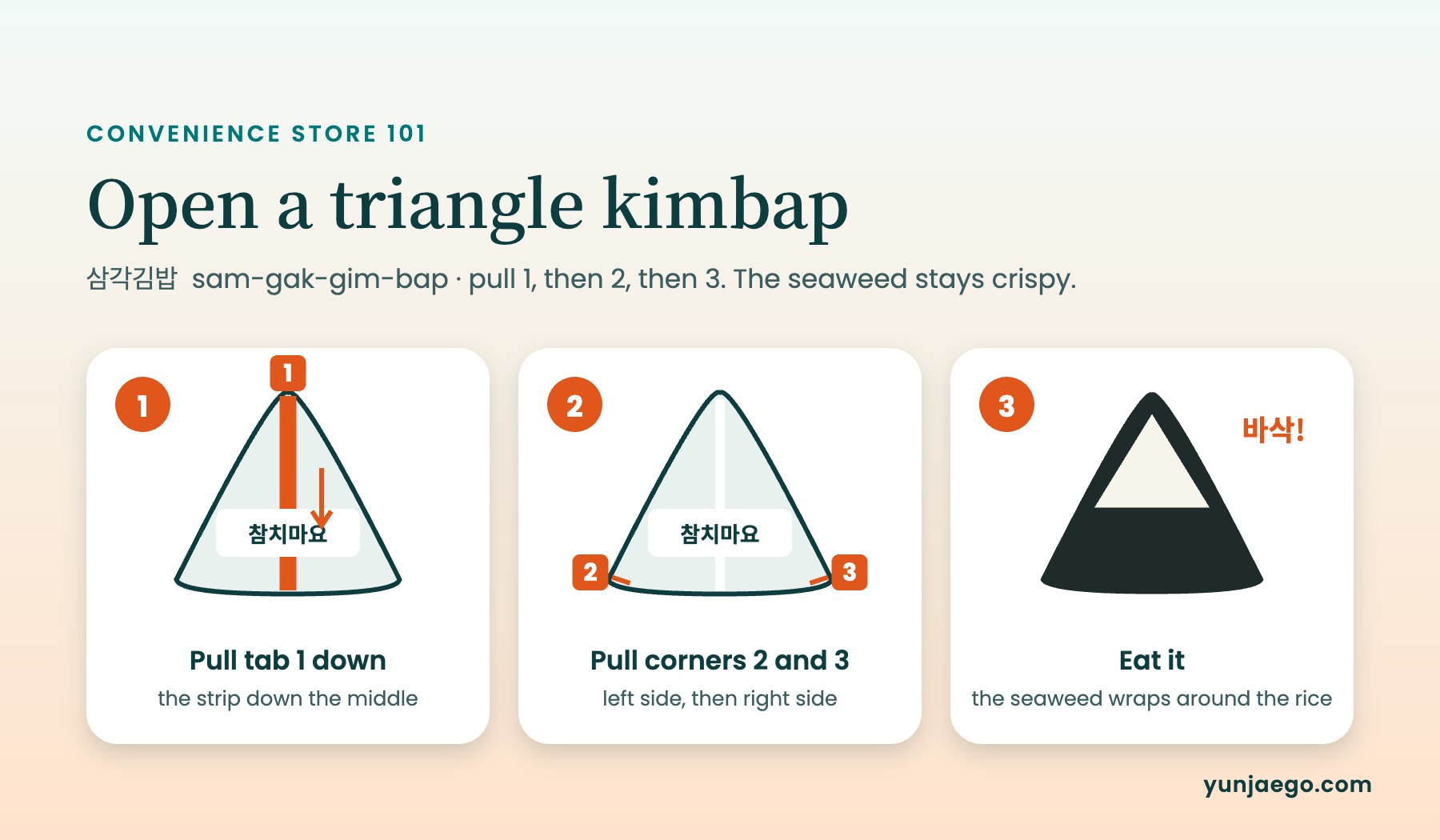
- Triangle kimbap (삼각김밥, sam-gak-gim-bap): pull strip 1 down the middle, then 2 and 3 on the sides. The seaweed wraps itself around the rice and stays crispy. Want it warm? Microwave it in the wrapper for about 20 seconds first.
- Cup noodles: hot water from the dispenser, fill to the line inside the cup, lid on, wait 3 to 4 minutes.
- Eat right there. Most stores have a counter by the window. Totally normal.
Getting around Korea: bus, subway and taxi
- Bus with a friend? Speak first, then tap. Tell the driver 두 명이요 (du myeong-i-yo), "two people," BEFORE you tap your card. Three people = 세 명이요 (se myeong-i-yo).
- Tap again when you get off the bus. Otherwise you miss the cheaper transfer to the next bus or subway.
- Subway: one card each. The gates don't do groups.
- Leave the special seats empty. The seats at both ends of each car are for the elderly, and the pink seat is for pregnant women. Even when they're empty, don't sit there. Locals will glare.
- Taxi: book it, don't wave one down. Use Uber or Kakao T. You see the route and the price, and the ride is saved if you forget something.
- Use the Korean address. Copy it from Naver Map and paste it in. English names often don't show up.
- Kakao T needs a KakaoTalk account. Set it up before you fly, not at the airport at midnight.
- Get out on the sidewalk side. In many taxis the left back door won't open from the inside. Doors aren't automatic either.
- Coming from the airport with suitcases? City buses don't take big luggage. Take the airport limousine bus.
How to pay for the subway and bus in Korea (2026)
| Your phone | What to do |
|---|---|
| Any phone | Buy a T-money (티머니, ti-meo-ni) card at any convenience store and top it up with cash. Works on the subway, buses and most taxis. |
| iPhone | Add T-money to Apple Wallet. Since April 2026 you can top it up with a foreign Mastercard in the Mobile T-money app. Then just tap your phone. |
| Android | Google Pay doesn't work in Korea. Get the card. |
Tapping your own bank card at the gates or on buses doesn't work yet. It's planned for around 2027.
Apps to download before you fly to Korea
- Naver Map (네이버 지도): Google Maps still misses a lot here. Use this for walking, buses and the subway. You can also check a restaurant's menu before you go.
- Papago (파파고): point your camera at a menu or sign and it translates.
- Uber or Kakao T: for taxis (see above).
- Data from the moment you land: all of these need internet. The easiest fix is an eSIM you set up at home. Get a Korea eSIM (SKT network) → (affiliate link)
Staying safe in Korea: ignore the friendly strangers
Korea is very safe. One thing is still worth knowing. Koreans even have a meme for it: 도를 아십니까? (do-reul a-sim-ni-kka), "Do you know the Dao?"
In tourist areas like Myeongdong or Hongdae, two friendly young people may stop you. They say they're students promoting Korean culture and invite you to a free "traditional ceremony" nearby. It ends far from where you started, with a request for money.
Smile, say 괜찮아요 (gwaen-chan-a-yo), "no thanks," and keep walking. You don't owe them your number or your Instagram.
| Number | Who you reach |
|---|---|
| 1330 | Korea Travel Hotline. 24/7, in English. Lost, confused or overcharged? Call this. |
| 112 | Police |
| 119 | Ambulance / fire |
Get the free Survival Korean PDF
Everything above, made to keep on your phone. Both are free.
- The cheat sheet (2 pages): for on the ground. The phrases, the signs, the apps and the help numbers on two pages.
- The full guide (14 pages): for the plane. Everything in this post, plus bars and soju, 30 dishes Koreans actually eat, toilets, tax refunds, free palace entry in hanbok, what to do if you lose something, where to go after Seoul, and where I'd stay in Seoul.
If you'd like to leave a tip on the download page, thank you. You don't have to.
Want to read Hangul too? My second free PDF, Eat Your Way Through Hangul, teaches all 40 letters with hand-drawn Korean food and places, plus 84 travel words and how Korean numbers work. It takes about a morning.
Korea travel FAQ
Do I need to speak Korean to travel in Korea?
No. Subway signs in Seoul are in English too, and apps cover most of the rest. A few phrases make a big difference with older restaurant owners and taxi drivers.
Is English widely spoken in Korea?
Young people and hotel staff often speak some English. In small restaurants, markets and taxis, much less. That's where the phrases above help most.
How do you say thank you in Korean?
감사합니다 (gam-sa-ham-ni-da). It's polite and safe with anyone. 고마워요 is for friends or people younger than you.
Do you tip in Korea?
No. There's no tipping in restaurants, cafés or taxis. That's partly why many restaurants are self-service for water and side dishes.
Does Google Maps work in Korea?
It works, but it still misses a lot here. Locals use Naver Map, and so should you.
Can I use my credit card in Korea?
Almost everywhere. Still, carry ₩30,000 to 50,000 in cash for traditional markets and street food stalls.
What do you say when you leave a restaurant in Korea?
잘 먹었습니다 (jal meo-geot-seum-ni-da), "I ate well." Owners love it, and almost nobody expects it from a foreigner.
Close enough is fine
Nobody in Korea expects you to speak Korean. So even a clumsy 감사합니다 gets a smile, and a 잘 먹었습니다 on the way out makes the owner's day.
I share more of this on Instagram: what to eat, what to skip, and what nobody tells you before you land. Come say hi at @yunjaekorean.